Tuesday, 23 May 2017
Greater Manchester
I am still reeling from the news of the events at the Arena last night.
The softest of soft targets, teenagers with their friends and parents, mostly girls and women. Violent death and injury is unbearable in any circumstances but the effects of this attack will be part of people's lives for generations to come.
Last week I was at my aunt's funeral with my mother. She still talks about the Manchester blitz. She was only a child then, and noone knew if her older sister was alive or dead until she walked back through the door the next day. Some of my friends on facebook are counsellors and trauma therapists. They are offering their services. Others are sharing contact numbers and photos, offers of help.
Manchester is where I'm from, where many of my friends live and work, where I went through the rites of passage of going to concerts and gigs with friends as a young teenager. Years later I took my children to events and concerts there, sharing the experience, bonding over the music. I have worked on the door at clubs including the Hacienda. Many of my friends have connections to the music business in the city and beyond.
I have been that parent waiting outside the venue. I have been that parent inside the venue with them. I have been that parent waiting for them to come home with someone else's.
The media circus that takes over when an event of this enormity happens is harrowing. but in among the eye witness accounts and the heartbreaking stories is the strong message that this is greater Manchester. People are coming together, rather than being divided. For many reasons I am proud to say I come from Manchester and today is one of them.

Tuesday, 2 May 2017
Any Port in a Storm
A couple of months ago I was travelling to the West Country by train. I had a lot on my mind and I knew reading a book wasn't going to be enough to distract me. I'd seen a short story competition on the Gifford's Circus Facebook page and I thought I'd have a go. Only 500 words on the theme of this year's show, Any Port in a Storm. I had a couple of ideas. As I travelled towards Devon, I recalled my brief time at Exeter University. In 1972 I spent a term there. Homesick for my friends in the North I was back by Christmas. There were some interesting times though and one involved going to the Tar Barrel Festival in Ottery St Mary around Bonfire Night. There was a fair in town that was straight out of a Thomas Hardy novel. Sideshows included a two headed calf and a five legged lamb. There was even a mermaid sitting in a glass tank. Somehow she found her way into my story. Last week I was thrilled to learn that I have won the competition. I get tickets to the circus, but what's even more exciting is that my tale is printed in the circus programme. When I go to the show Tweedy the clown will read my story out loud! I'm so thrilled to be part of the circus.
Monday, 13 March 2017
Manannan's Cloak
There's a tradition in the Isle of Man. When the Island needs to hide or keep a low profile, Manannan Mac Lir, the Celtic sea god, throws his cloak over it.
He did just that on Friday morning. I was booked on the morning flight from Manchester to make a flying visit to see my aunt, my godmother, in hospital. My mother and one of my cousins were with me. They had managed to book on the early evening flight back, but I could only get a return seat on the late afternoon one.
When we got to the Departure Lounge we realised just how uncertain our outward journey was. Cloud over the Island was preventing all flights from leaving or departing. Realising how tight time was going to be, I nearly relinquished my bookings. I had found out how to exit Departures if I couldn't leave on a plane, something you need to consider nowadays with airport security. I was quite philosophical, joking that I'd had a day out at the Airport.
I would not have been quite so accepting if I had realised that my aunt had had the Last Rites the day before. I thought I was making an overdue hospital visit.
Suddenly the departure time pulled back by 20 minutes. Given a fair wind and another cousin's car, I could just about make it to the hospital for a twenty minute visit. Thank goodness Ronaldsway Airport and Nobles Hospital are built on a human scale, taking minutes to negotiate.
Going back to the Island and saying goodbye to my aunt was an intensely emotional experience. I was so glad I had been able to get there.
Travelling to the Island aged three was my first trip on a plane. In my teens long haul flights were a way of life, and the memory of that island hop was a comfort when I felt nervous. I had two aunts and a great aunt and uncle on the Island. Their friends introduced me to folklore and local history in a way that has inspired and informed my interest and study of both subjects throughout my life.I had never experienced the immediacy of the past and of legend in that way before. There have been so many family holidays, through several generations,including trips to the TT in my motorcycling days. It's a magical and much loved place for me. Often we would travel by ferry from Liverpool's Pier Head, from that wonderful historic Embarkation Hall that no longer exists except in memory. Sometimes I travelled alone, for school holidays, choosing to stay on deck, curled up on a huge coil of rope with a good book.
Friday's flying visit is one of the most significant, though the good news this morning is that my aunt has rallied over the weekend. I am prepared for other flying visits to the Island in the days and weeks to come.
I hope Manannan is on my side.
Thursday, 2 March 2017
Regrets, I've had a few
I am a regular listener to Radio 3's Late Junction. I like the different presenters' individual approaches to the music they feature. I always enjoy Max Reinhardt's choices and this week has been amazing. I often fall asleep to the sound of something new to me, and I am very grateful for the programme's website. Recordings of Pharoah Sanders playing with Gnawa musicians in Essouira has been a particular pleasure. I try not to do regret, but back in 1981 I was spending a few days in Essouira before I returned to England after a year's teaching English in Morocco. I was travelling with two girl friends. One evening there was a knock on our hotel door. A new Moroccan friend had come to invite us to listen to some traditional music. Not all of us wanted to go, and we had an agreement that we would stick together. We were a little uncertain of what was on offer. I realise now that this was an invitation to listen to Gnawa music, and it is one of the regrets of my life that we didn't take a chance. Who knows what we missed. Listening to Late Junction this week has made me wonder.
Saturday, 21 January 2017
Move on up
An article about Curtis Mayfield popped up on Facebook today. Singing his praises for the role he played in the Civil Rights movement, singing his praises for his beautiful voice and inspirational lyrics.
Last week I was enjoying a coffee and chat in the wonderful Cafe #9. Move on Up came on over the speakers. It's a song that always stops me in my tracks. It has on occasion made me cry in public. It was released as I was going through a dreadful time in my late teens, and it became a personal anthem. Curtis Mayfield's lyrics both comforted and encouraged me. ' Hush now child, and don't you cry, your folks might understand you by and by'. But the line that always leaps out is 'Take nothing less than the second best.'
A light hearted but serious discussion broke out in the cafe. My friend revealed that he had interpreted this as the ultimate compromise. The song and the singer had disappointed him as a result and it had lost its meaning for him.
For me, at the age of seventeen, these words were realistically comforting . Curtis seemed to be saying that you could get where you wanted to be in steps and stages. Keep expectations and dreams manageable and you won't be let down or disappointed.
In time I realised that he was writing about the Civil Rights movement as much as he was writing something relevant to my teenage dilemmas. In the week when the world's attention has been focussed on America, and history seems in danger of moving into reverse gear, Curtis Mayfield's music has never seemed more relevant.
Saturday, 7 January 2017
Wood for the trees
Today I have been on a demonstration. Organised by STAG, the Sheffield Trees Action Group, we encircled Sheffield Town Hall with yellow ribbons to raise awareness of the plight of Sheffield's trees.
If you have been following the tale of the trees in Sheffield you'll know that a dawn raid to cut down trees on Rustlings Rd made the world news a couple of months ago. If you are familiar with Sheffield as a city, you will also know that its leafy suburbs and urban woodlands, combined with a setting flanked by hills and defined by river valleys, snaking out to the Peak District, all make Sheffield one of the greenest and most attractive cities in the country. Sadly the local council doesn't seem to be able to see the wood for the trees, and have committed to a contract that involves felling healthy mature trees in order to do work on pavements and utilities.
When the news broke about Rustlings Rd I was reminded that my late father in law was born there. As we wait for the arrival of the second baby in our family to be Sheffield born, I have thought about the city he was born into. Did he hear the leaves rustling outside his bedroom window? He didn't live here for long. We all thought he was from Widnes! It was only when we moved to Sheffield in the early 1990s that he revealed it was his birthplace.
Listening to Radio 4 this morning, I heard an item on the problems and dangers of city pollution. Trees and green spaces are one of the answers to minimising its harmful effects, improving health and the quality of life as urban sprawl spreads. Ironically much of Sheffield's urban woodland is a legacy from its early days as an industrial centre. Smelting required charcoal, also known as white coal. Woodland was managed to provide the fuel needed. Nowadays this same woodland is a rich resource, both environmentally and ecologically. Tree lined roads help balance traffic pollution. Sheffield is streets ahead, and other cities should be green with envy at what Sheffield residents take for granted and the local council seems unable to appreciate. Looking back at the woodland heritage of the area, management was key. It is obvious that opportunities for managing the rich resource of Sheffield's trees have been badly handled, as has the public relations disaster of recent felling.
As we circled the town hall with yellow ribbons, wearing yellow coats, jumpers, hats and scarves, whatever we had got to make a splash of colour, there was a real sense of celebration and purpose. Once upon a time we might have been dismissed and disparaged as tree huggers, but environmental science and town planning is on the side of the trees now. From fuel for the furnaces to safe air to breathe, we have so much to thank them for.
Saturday, 24 December 2016
Christmas present
I read another blogpost from an old friend today. Like me, she hadn't posted for a while, and like me she has had a big year of changes on a personal and family level. We both grew up politically through the sixties and seventies, and like me, she is struggling to make sense of what is happening as we move towards a new year and what seem to be turbulent times. The dark days of winter are symbolic of many things. A time for growth, underground and unseen, ready to burst forth in Spring. A time of hibernation and dreamimg, as we prepare for the challenges of the new year. And because we don't hibernate like the lucky bears and tortoises, the butterflies and the dormice, it's a time when we can surround ourselves with those we love. If they can't be there in person, they are there in spirit.
My own run up to Christmas has been a strange one. Working in an environment that makes a commercial business out of people's desire to get into the Christmas spirit, the pressure to fulfill visitors'expectations has been exhausting and relentless since early November. Work colleagues have been a great support, and there have been some magical moments scattered like fairy dust, but serving up the Christmas experience is very different from enjoying it.
Inevitably at this time of year, I have a sense of Christmas past. Childhood memories of waiting for Father Christmas, the first Christmas when my dad was working abroad, the first Christmas when both parents were abroad and we travelled on our own, three young sisters, from a miserable boarding school in Derbyshire to the exotic jungles of Borneo to join them. A Christmas in Casablanca and Tenerife. A Christmas when I dropped out of University. A Christmas waiting for a January baby, just as my daughter is doing now. Christmas with and without my children, as we took it in turns as parents after my marriage broke up. If I put my mind to it, I can probably recall where I was and how I felt for most years since childhood.
This Christmas present has been about helping my daughter and son in law turn their first house into lovely home for them and their imminent first baby. It's about having my children with me for our first Christmas in my new home. It's also about the relief of knowing my mother has managed a successful move to a new flat at the age of 87, thanks to help from other members of the family, who pulled out all the stops when I couldn't.
This Christmas present is also about the pride I feel for my three children and their achievements this year. Christmas future is about having a grandchild to join us all next year.
Sunday, 18 December 2016
A single to Sheffield
I often ponder my relationship status, having been single for many years now. There have been times when I have longed to meet a soulmate. There have also been times when I thought I had, only to be disappointed. I've been thinking about this topic as a suitable subject for discussion for a while, and I have to admit that it is the inclusion of the fictional singleton, Bridget Jones, on the Woman's Hour power list this week that has spurred me to action. Much as I enjoyed the book at the time, I can't begin to identify with her desperation and never did. At a completely different stage of life, with three children, two former marriages and about to become a grandmother for the first time, I can look back over my years as a single parent and responsible adult with a sense of achievement. I embrace my single status and appreciate celibacy and all. Sometimes I wonder if I'm a natural nun, in spite of the traumas of a convent education. Do I have trust issues? Definitely ! I also love my strong friendships and they haven't always been compatible with being one of a couple.
There are times when it would be wonderful to have someone in my corner with practical help and emotional support. To have someone make me a cup of tea first thing in the morning and rub my back last thing at night. Someone to admire and appreciate me. I think it was Adrian Henri who wrote' Love is a fan club with only two fans'.
I'm lucky because I see those strong and loving relationships close by me, for my children and my good friends. I know they exist and I can admire and appreciate them.
Over the years I've resisted well meaning attempts to match make or to get me to sign up for Guardian soulmates and Internet dating. Not my way, though I'm sure it works for some.
There are times when I wish I was part of a couple. I never expected anything else when I was younger. There are times when I realise how much I enjoy living alone. There are issues of freedom and status in society that still take me by surprise. People say a trouble shared is a trouble halved, but I am aware that in a relationship the opposite can happen, and it results in double trouble. Life is so complicated!
So thank you family and friends for being the love of my life.
Monday, 12 December 2016
Stumbling on the side of twelve misty mountains
Bob Dylan's song A Hard Rain's Gonna Fall has been in the news this week. Patti Smith sang it for him at the Nobel prize ceremony, stumbling over the words of the second verse, the black branch with blood that kept dripping. It's a song I have been familiar with since it was first recorded, thanks to my father's passion for Dylan, Joan Baez, the Clancy Brothers and Tommy Makem and the rest.The lyrics have meant different things at different times in my life and I associated them with the civil rights movement, the Cold War and nuclear threat during my teens. Listening to the lyrics again this week, images were conjured up that reflected the history of the last half century, images that didn't exist in popular consciousness when the song was written. The song looks to the past and to the future in its form and meaning in a remarkable way. It comments on world events, environmental concerns, politics, war, famine and greed in a way that is as relevant now as it was in 1962. That should be depressing, but somehow it isn't because it's the fate of a poet to speak to truth, to enlighten and to create awareness. From awareness comes the opportunity to make changes.
One line leapt out for me : I've stumbled on the side of twelve misty mountains.
That line sums up this year for me. Each month has brought unexpected challenges. I've been negotiating my way through unfamiliar paths, uncertain if I'm heading in the right direction across those misty mountains. But as the landscape of the year reveals itself, as the sun breaks through the mist, I'm aware of a huge sense of achievement for myself and my loved ones.
I salute the poet.
Friday, 2 December 2016
What will survive of us is love
Listening to the news this morning, I heard an item about Philip Larkin's memorial stone in Westminster Abbey. It doesn't include what has become his most famous quote, but it does include the equally meaningful line I have chosen as the title for this post.
A friend asked me this week ' What's happened to the Ditch?', and I realise it's been months since I wrote on this blog.
There are several reasons for my silence. One is to do with my move earlier this year. Prosaically, now I'm living on the Edge I'd wondered whether to change the name. In reality I live below Brincliffe Edge, but the play on words works as this has been a challenging year, beginning as it did with a major move. And those challenges, which have involved family and friends in my close circle as well as political events in this country and elsewhere, haven't stopped me thinking, but they have made me reconsider my writing and what it's all about.
As the national and world view became more incomprehensible to me, I found myself focussing on those I love and their place in my life. Focussing on what I can understand, influence, support and cope with. This doesn't mean I haven't tried to get to grips with Brexit and Trump (and the rest), but I need to be grounded in my own world when the wider world seems so alien.
It has been a year of dislocations. Not only have I moved, but my children have had moves and changes. Even my elderly mother is on the move. It's been about finding personal places of safety and refuge, comfort zones and familiarity. For me, it has been about moving back to an area I knew over 23 years ago and finding my place here. It's been a good move and next week I will have my daughter and her husband living round the corner, with a baby on the way. First time granny. I can't wait.
So I have been thinking a lot about living in hope. It isn't naivety. Hope is as important as love. It comes back to the old trio of faith, hope and love. So when I woke this morning to Philip Larkin's quote it made a lot of sense.
Perhaps one day I will write about his better known quote!
Sunday, 28 August 2016
Back to school
It's the season of mists and mellow fruitfulness once more. The shift from late summer to autumn, when you realise that the possibility of a perfect summer has fled. Autumn may be lovely, but the nights draw in, there's a chill in the air in the morning in spite of the promise of a sunny day. Birds are gathering, heather is flowering and the rowan berries brighten the trees. My journey to work through the Peak District is increasingly beautiful, dark green, orange and purple under a clear blue sky, criss crossed with vapour trails. Lines from songs run through my head, all around the blooming heather, the birds on the telegraph line this time. Too late for the summer, but not quite late September when I really should be back at school. Coincidentally my journey to work retraces some of my journey back to boarding school in Derbyshire. Leaving home in Sheffield one morning last week I was overwhelmed by the familiar feeling of dread and longing that accompanied the days leading up to my return to school after the summer holidays. It was something to do with the scent of vegetation after rain, the chill air and clear blue sky, the rowan trees in residential gardens.It may go deeper than that, as the days and nights move towards the equinox and like a bird, I feel it's time for me to leave, with all the emotions that accompany that feeling. Of course I don't have to go anywhere. September hasn't been a physical or geographical turning point for me since my teenage years. But somehow it's deep within me. The dark months of deepest winter don't affect me emotionally in the same way this time of year can. My summer holidays in those boarding school years weren't conventional. I travelled to the far east to join my parents and came back to England via my home town of Manchester, staying with friends and relatives for short periods of time. It was an intense experience. The far east wasn't my home, and I no longer had a home in this country. Yet homesickness was overwhelming and that mix of anxiety, longing and nostalgia can still overwhelm me when I least expect it. I have talked to other boarding school survivors over the years and I think for many of us, this is a difficult time of year. It's a time of separation and loss, of a sense of abandonment, the precious last few days of freedom. With my own children it was a time for buying shoes and stationery, school uniforms and dinner money. Back to the routine of school days,but with home to return to each evening.
There's a Welsh word for it, hiraeth, with no direct English translation. It's defined as homesickness tinged with grief or sadness over the lost and departed. I can't help feeling it's a word that would be useful for many people in the world today.
Sunday, 31 July 2016
Arbor Low: A sense of place revisited
Sense of Place
Arbor Low
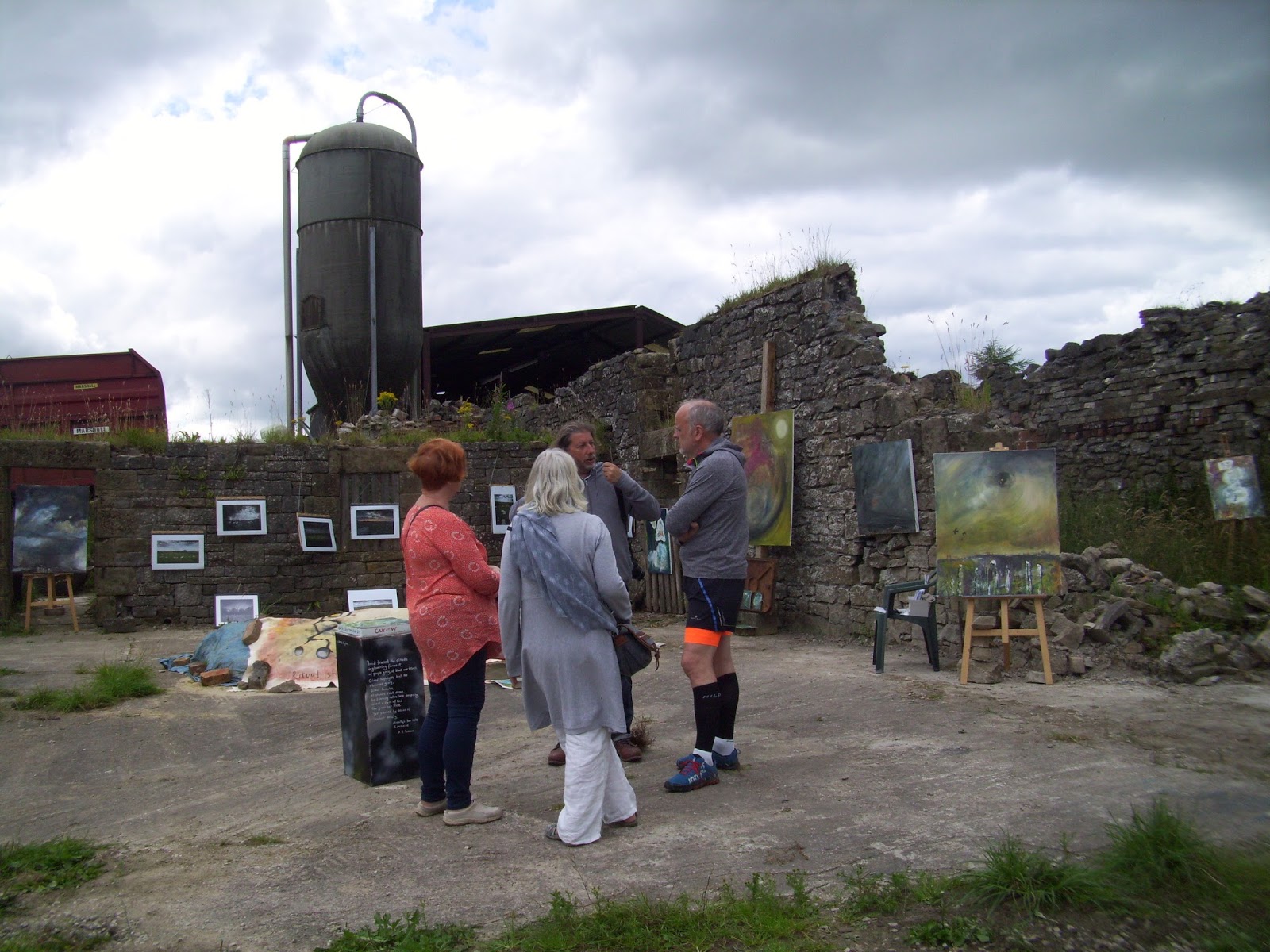
Artist Keith How and photographer Billy Bye held an exhibition of their work at Upper Oldhams Farm, Arbor Low this weekend.
I wrote some words.


 Mysterious and awe inspiring for thousands of years, folklorists, antiquarians and archaeologists have their own theories about its historical and cultural significance. Whatever might be their truths, those ditches were dug, those stones were shifted for a purpose. Nearby Gib Hill has its own story, dating back to the Bronze Age. Roman soldiers gazed in wonder as they marched past on their way North. What did they make of it? Did they recognise something and compare it to Stonehenge and Avebury, or the Bull Ring, its sister henge in Derbyshire?
Before the stones were laid, before the cove was created, before this plateau of Middleton Moor found its level above the sea, tropical lagoons covered this landscape, sea creatures lived and died, their skeletons forming the beds that became the limestone rocks, now fissured and worn, with their own rock pools of rainwater. Bones and stones. A human skeleton was buried in the cove, the group of rocks in the middle of the circle. Another was cremated, ashes buried in the kist at Gib Hill.
Look around and notice the lie of the land, the shapes of the henge echoed by the far horizons of the surrounding hills. Look above to the heavens. Enter the spirit of the skylark and see the shapes from the air. It could be a clock face, it might be a heart, it’s an oval, an egg. Timeless and eternal, in the present it’s a focus for awe and love, pagan spirituality and nature worship. It’s a portal and a place to connect with people who share a common purpose and a shared love for the environment and wild places, who care about the spiritual and natural environment, who need a sense of belonging in their local landscape and the cosmos.
This place has had its champions and custodians over the centuries. There is a welcome to enter in from those who live here. They understand its importance. Solstice celebrations at the turnings of the year bring visitors. Ice sculptures are created from blades of grass in December, paths are hidden in the mist. In June the sound of drums accompanies the skylarks’ song and the planes flying overhead. Throughout the year, in any season, there are those who find their way here with a bunch of wildflowers, a crystal, a drawing, an offering left in a cleft of the stones. It’s a place of pilgrimage and a place of deep connection.
Mysterious and awe inspiring for thousands of years, folklorists, antiquarians and archaeologists have their own theories about its historical and cultural significance. Whatever might be their truths, those ditches were dug, those stones were shifted for a purpose. Nearby Gib Hill has its own story, dating back to the Bronze Age. Roman soldiers gazed in wonder as they marched past on their way North. What did they make of it? Did they recognise something and compare it to Stonehenge and Avebury, or the Bull Ring, its sister henge in Derbyshire?
Before the stones were laid, before the cove was created, before this plateau of Middleton Moor found its level above the sea, tropical lagoons covered this landscape, sea creatures lived and died, their skeletons forming the beds that became the limestone rocks, now fissured and worn, with their own rock pools of rainwater. Bones and stones. A human skeleton was buried in the cove, the group of rocks in the middle of the circle. Another was cremated, ashes buried in the kist at Gib Hill.
Look around and notice the lie of the land, the shapes of the henge echoed by the far horizons of the surrounding hills. Look above to the heavens. Enter the spirit of the skylark and see the shapes from the air. It could be a clock face, it might be a heart, it’s an oval, an egg. Timeless and eternal, in the present it’s a focus for awe and love, pagan spirituality and nature worship. It’s a portal and a place to connect with people who share a common purpose and a shared love for the environment and wild places, who care about the spiritual and natural environment, who need a sense of belonging in their local landscape and the cosmos.
This place has had its champions and custodians over the centuries. There is a welcome to enter in from those who live here. They understand its importance. Solstice celebrations at the turnings of the year bring visitors. Ice sculptures are created from blades of grass in December, paths are hidden in the mist. In June the sound of drums accompanies the skylarks’ song and the planes flying overhead. Throughout the year, in any season, there are those who find their way here with a bunch of wildflowers, a crystal, a drawing, an offering left in a cleft of the stones. It’s a place of pilgrimage and a place of deep connection.


Saturday, 30 July 2016
1966 and all that
So it's 50 years since England won the World Cup. This morning the presenter of Radio 4's Thought For the Day harked back to 1966. He described it as post-war, with bomb sites undeveloped among the city and suburban streets. I remember it well. Manchester's Arndale hadn't yet been built. The city centre was Dickensian. There was a bomb site where my sister and I played near our house. Close by was an area of devastation known as Swinton Fields. We rode our bikes there, up and over embankments for long demolished railway tracks.
On July 30th 1966 my sister and I were staying with my godmother, my aunt in the Isle of Man. School summer holidays, we were aged 11 and 12. Normally we would have been down on the stony beach at Port Jack, skimming stones, climbing rocks and making use of the disguised sewage pipe to walk out into the waves, past the cave in the cliff. But for some reason, though we weren't football fans, we stayed in, watching the game on her small black and white television. My aunt's flat was on Royal Terrace.The first floor living room had a bay window overlooking Douglas Bay from Onchan Head. While she lived there, I've seen the Red Arrows fly so close over the headland and past that window that you could imagine you saw the colour of the pilot's eyes. It was a sunny afternoon. We watched with concentration and fascination, calling my aunt in to join us for the last fifteen minutes. It was impossible not to get caught up in the excitement of the result, and in my mind's eye I see it in glorious colour.
Saturday, 25 June 2016
A sense of place
It's only a couple of weeks since I spent a day thinking about the notion of a sense of place, thanks to the Humanities in Public initiative at Manchester Met and one of their events, held near Hope.
I was full of inspiration to write about places I know and love, mostly in this country.
Today I feel like a stranger in a strange land. Ironically the success of the Leave vote in the EU referendum has made me feel like I'm living in a foreign country. I'm struggling to recognise it.
I was shocked that Sheffield, my new home, known as a City of Sanctuary, voted Leave. As a region South Yorkshire benefitted from EU funding when no-one else wanted to know. Memories are short it seems. I couldn't continue listening to the Radio 4 special from here this morning. I don't know anyone round here who thought we should leave, but I may be making assumptions. I'm very aware I have misread the attitudes of some friends and family members over the last few weeks. It's been even more difficult to second guess colleagues , though I have been comforted by support at work in the last couple of days. The shock of the result of the vote was much greater than I had anticipated yesterday. It seems many others felt the same, sick, despairing and full of dread for the future.
I've grown up through the Cold War years, with the threat of nuclear war, through the Thatcher and Reagan era, the Falklands War, the first Gulf War, the Troubles, the disappointment of the Blair years and a second Gulf War, recessions and three day weeks, fuel crises, racism and right wing threats. I've nailed my colours to the mast and been actively involved in alternative approaches to the economy, the spiritual life, education and good health. I'm stoical and I'm a survivor. I know I'm not alone.
These are unpredictable times. What is predictable are the broken promises to the Leavers and a damaged economy for all. At the moment the news seems dominated by Eton rivals and particularly vicious party politics.
After the shock and numbness of the last couple of days, it's time to take stock and refuse to feel helpless. There's never been a greater need for hope.
Thursday, 9 June 2016
Paul Graney's archives
On Tuesday evening I went to a talk at Central Library in Manchester about Paul Graney. Organised by Archives+ as part of the Manchester Histories Festival, it was free and only an hour long. David Govier and Fiona Cosson had done a great job distilling a life time of recording, witnessing and collecting into an introduction to Paul Graney's achievements. There were people in the audience who knew him and appreciated his role in collecting social history, folklore and folk music, including Barry Seddon, who has done so much work with his archive and Mike Harding, who was thrilled to see photos of the first Middleton Pace Egg play revival from 1967, featuring him in the role of The Doctor (no, not that one).
The extracts from interviews and recordings were great to hear. The taped letters from around the world and the live performance of a collected traditional song about mill girls added to the experience. A lot was packed into that hour, which was over far too quickly.
I love listening to this kind of witnessing - oral history interviews, music recordings, interesting radio programmes.
As each piece was played, I could relate to it, recognising some connection with my own life and work, even though I never met Paul. My own beginnings in folklore studies took place on the other side of the Pennines in West Yorkshire, and my involvement in social and oral history didn't happen until after Paul's death in 1982.
The tape letters, sent between contacts world wide, reminded me of the reel to reel recordings my sisters and I made for my dad when he was working in Nigeria. Nowadays those people would be using social media and the internet to share news and opinions. Listening to forthright opinions on the new fashion for mini skirts took me back to my early teens. I wonder what that woman would think if she knew they still haven't gone out of fashion. Mention of Kennedy's assassination from an American correspondent took me back to the Friday tea time when my sister and I heard the news, waiting for our favourite programme on TV (Bonanza). My mum was doing the ironing in the kitchen. She burst into tears when we told her and I didn't understand why for many years. Ironically I spend some of my time at work talking to visitors about JFK and his visit to his sister's grave in July 1963. I also occasionally talk about Diana Moseley at work, and it was fascinating to hear Paul Graney's first hand account of clashes with Oswald Moseley's Blackshirts. The song highlighting the mill owners' opposition to the Ten Hours Act was wonderful, sung live - 'on the backs of the Lancashire lasses'. Having recently worked at an industrial mill museum in Derbyshire, with its links with Arkwright and Lancashire cotton, it was very poignant. It was terrifying to hear Paul talk about his own initiation experience in the mills of Burnley. A dark cellar, loom grease, cotton lint, a bag over his head and his trousers round his ankles while a group of mill women did their version of tarring and feathering.I'd heard similar stories from the conversations I've had with former workers at The English Sewing Cotton Companies' mill in Belper. There the initiations took place on the works buses home and involved losing trousers.
He also had plenty to say about libraries and librarians. When living as a tramp he had looked to libraries as a place of warmth and shelter, and harboured a lifelong resentment towards those officious female librarians who had shown him the door. In the early seventies there was a gentleman of the road who walked to Salford Central Library daily, resting and reading the paper in the reference section. A charming man. Many years later, a similar gentleman spent his days in another small branch library where I worked, accepted and welcomed by the staff if not always by the users of the library.
I know Archives+ are looking for ways this particular collection can inspire and create responses. It's an amazing resource available for sharing and a great legacy for the man and his dedicated friends who have made that possible.
Friday, 3 June 2016
Wise moves
Many years ago, when I was part of the Bakewell Arts Festival, I had a dream to book John Cooper Clarke as part of the fun. He wasn't in a good place back then, and I was wisely warned off pursuing it by someone who knew the score. To my amazement he was booked in at Bakewell Town Hall as part of his tour with Mike Garry on Wednesday night. You give up on Bakewell and move to Sheffield and look what happens! I went back to Bakewell to see him and a great night was had by all. I was trying to remember when, where and how often I had seen him back in the late seventies. Alan Wise must have been his manager through some of that time. I was reminiscing about all the support slots he did back in the days when I did the door for Alan Wise. By Thursday afternoon I started to hear rumours that Alan had died, rumours that soon became a fact. How sad, so soon after the recent death of his daughter. Over the last few years I've heard people talk about the huge contribution Alan made to the Manchester music scene, unacknowledged for many years for many different reasons, not least because of the complicated approach to life Alan took. I read a great article in praise of him in a Salford paper today, pointing out that while Alan often owed money, we in fact owed him far more.
My own friendship with him began in the late seventies when I used to do the door for him at Rafters. I had a day job, but loved the buzz of those nights out. When I met up with him at a Martin Hannett event a couple of years ago, he described me as his best ever door girl. For all I know he said that to all of them, but I'm proud that he thought that and remembered to tell me all those years later. I have a theory about it now I'm older. It never occurred to me to help myself to any of the takings, put my mates on the guest list or skive on the job. I was reliable and loyal. Thanks to those nights working for Alan - and he never owed me money, I was always paid - I saw some great music and comedy and met some fantastic people. It's an era of my life that has its own complications. As a result of something that happened whilst I was working for him, I ended up running away to Morocco and working there for a year. Once I came back, I did meet up with him again, but then the Hacienda opened and my part time door job found a new home.
Last time I saw Alan, he asked me to send him a Bakewell pudding. I did. I hope he got it. I suspect he would have preferred a Bakewell tart.
There are rumours that he was working on a book, and I know he had written some memoirs. He appears in James Young's book about Nico, 'Songs They never Play on the Radio', as Dr Demetrius. Fact or myth, I know we will not see his like again.
Thursday, 12 May 2016
Remnants

Saturday, 7 May 2016
Arabian Nights

Tuesday, 3 May 2016
Body image
Since moving to Sheffield I have met up with a lovely group of young talented musicians, mostly thanks to friendships forged with my youngest son when he moved here.
One of them, the lovely and very talented Fran, has set up a Facebook group, inspired by Movember and Dry January, called MAY, I Love My Body. She has invited friends to share and contribute positive messages and thoughts about self image and body awareness. She started sharing with a wonderful song by India Arie. 'Sometimes I shave my legs, sometimes I don't'. What a great line. The song continues to be such a positive and uplifting message about being yourself, not always easy in any circumstances, but especially tricky in the music business.
I thought I'd enjoy the posts over the month of May, but wasn't sure about contributing. At the age of 62, I have seen fashions come and go. Not just fashions in clothes and dress, but fashions in looks, body shape, hair type, facial features - you name it. I thought I had reached a point where I truly believe that anything goes, that there are many ways to express yourself, to look good and that as an individual you can take confidence from that. Comparisons don't work. The phrase 'Comparisons are odious' was first recorded in use in the 15th century.
Van Morrison wrote the line 'All the girls walk by dressed up for each other' in his song 'Wild Night'. Of course it isn't only girls who judge themselves against their contemporaries.
I find the vogue for plastic surgery horrifying, as much because of my fear of needles, stitches and hospitals. I watched the TV adaptation of Fay Weldon's Life and Loves of a She Devil and it had a lasting effect. I also grew up in the sixties when an apparently effortless natural look was chic. Think Jean Shrimpton and Julie Christie.
So Fran got me thinking. I've been lucky. My weight doesn't change much. I feel healthy and eat well. It's easy for me to find fashionable clothes and small sizes often end up in charity shops too. My hair grows and I have never had to colour it. It's turning silver rather than gold, but it's an easy look to maintain. My teeth are my own. My toe nails aren't so good but a bit of polish sorts that in the summer. However I am aware that it could have gone another way. Boarding school created some strange eating habits. I hated the school food, especially as I disliked meat. I lived on cereal, cakes and biscuits. There was a tuck shop and we could buy extras, so I think most of my friends could eat a whole cake or a whole packet of biscuits at a sitting. In the late 60s I had never heard of anorexia or bulimia but that didn't mean it didn't exist. Looking back on schooldays I can identify friends who suffered from one or the other - or both. I was Twiggy style and could eat as much sweet stuff as I wanted. I probably weighed about 7 stone. But I do remember a skinnier friend's brother describing me as 'stocky'.Luckily I didn't take it too seriously, though the fact that I remember it all these years later means it struck home. His sylph like sister did go on to be a photographic model in those stick thin days.
Noone ever told me I was nice looking or pretty or anything like that through my teens. My parents were on the other side of the world and I don't think it occurred to them that my sisters and I might need a bit of encouragement. As I get older I also realise that my mother had (and still has!) her own issues around ageing, weight and image. Some of my friends were encouraging and kind but I never really got it about looks. Being brought up by nuns didn't help either. Vanity was considered a sin. So I find myself at an age when I can accept who I am and what I look like without any worries . I sometimes look at photos of myself when I was younger and regret that I didn't know what I had back then. It would have been nice to have been proud occasionally!
So to those of you reading this as part of MAY, I Love My Body, just do it.
Sunday, 1 May 2016
Carfree
After nearly 25 years of essential car ownership I have just made the leap to become carless!I didn't learn to drive until I was thirty and then had access to the family car once I did. I have an ambivalent attitude to driving, especially having waited so long to learn. It's complicated and I do trace it back to my own mother's lack of navigation skills when she had to learn to drive because my father was working abroad.I was designated navigator and at the age of nine it was sometimes traumatic.I like public transport and the chance meetings and interactions that result in bus and train journeys. I'm not a car person, though I do regret that I no longer have the VW Karmann Ghia my former husband and I owned back in the 70s.
In the last few months I have found myself unintentionally jobless and homeless, fortunately not for long. That wasn't part of the moving back to the city plan. But thinking about managing without a car was and yesterday I took the plunge. It was tempting to keep it for emergencies,or to trade it in for another secondhand car, but the truth is I wasn't using it and didn't need it. I get free bus travel to work, I live near to the shops I need and it's a short walk and an even shorter bus journey into town. I get trains if I'm going any distance. I am finally well connected.
I realised when I worked in Manchester that people were managing work and bringing up a family without a car. A social life was possible and entertainment was accessible without one. In Bakewell a car was necessary for access to work, to shops and to enable my children to have friendships and interests. I could get to concerts and gigs in Sheffield or Buxton by bus, but I couldn't get home. The nearest railway station was a car journey away, with bus links to it cut in the last few years. I remember signing up for the doctor's surgery in Eyam when I first moved to Bakewell. They were happy to supervise the home birth of my youngest. Only a few miles from Bakewell, I assumed there'd be a local bus service for my appointments when I didn't have the car. Once a fortnight on a Monday! That's one bus there and one back. I don't think even that exists any more. Community transport initiatives took up some of the slack for special groups, but not for the general public.
Time of course was a factor. The school and playgroup runs before and after work, the dashing about to manage it all.
So now when my time is more my own, I can factor in the choice of walk or bus journey, or even a taxi.
It's an experiment. I don't expect to be carless for ever, but I do want to be convinced I need one before I go looking. I am also in the fortunate position of being able to borrow one occasionally if I need to. I'm told there's a car club in Sheffield and I'd like to find out more about that too.
But for now I'm car free and carefree. Bye little Smart Car. It's been fun!


Subscribe to:
Posts (Atom)