Sunday, 28 August 2016
Back to school
It's the season of mists and mellow fruitfulness once more. The shift from late summer to autumn, when you realise that the possibility of a perfect summer has fled. Autumn may be lovely, but the nights draw in, there's a chill in the air in the morning in spite of the promise of a sunny day. Birds are gathering, heather is flowering and the rowan berries brighten the trees. My journey to work through the Peak District is increasingly beautiful, dark green, orange and purple under a clear blue sky, criss crossed with vapour trails. Lines from songs run through my head, all around the blooming heather, the birds on the telegraph line this time. Too late for the summer, but not quite late September when I really should be back at school. Coincidentally my journey to work retraces some of my journey back to boarding school in Derbyshire. Leaving home in Sheffield one morning last week I was overwhelmed by the familiar feeling of dread and longing that accompanied the days leading up to my return to school after the summer holidays. It was something to do with the scent of vegetation after rain, the chill air and clear blue sky, the rowan trees in residential gardens.It may go deeper than that, as the days and nights move towards the equinox and like a bird, I feel it's time for me to leave, with all the emotions that accompany that feeling. Of course I don't have to go anywhere. September hasn't been a physical or geographical turning point for me since my teenage years. But somehow it's deep within me. The dark months of deepest winter don't affect me emotionally in the same way this time of year can. My summer holidays in those boarding school years weren't conventional. I travelled to the far east to join my parents and came back to England via my home town of Manchester, staying with friends and relatives for short periods of time. It was an intense experience. The far east wasn't my home, and I no longer had a home in this country. Yet homesickness was overwhelming and that mix of anxiety, longing and nostalgia can still overwhelm me when I least expect it. I have talked to other boarding school survivors over the years and I think for many of us, this is a difficult time of year. It's a time of separation and loss, of a sense of abandonment, the precious last few days of freedom. With my own children it was a time for buying shoes and stationery, school uniforms and dinner money. Back to the routine of school days,but with home to return to each evening.
There's a Welsh word for it, hiraeth, with no direct English translation. It's defined as homesickness tinged with grief or sadness over the lost and departed. I can't help feeling it's a word that would be useful for many people in the world today.

Sunday, 31 July 2016
Arbor Low: A sense of place revisited
Sense of Place
Arbor Low
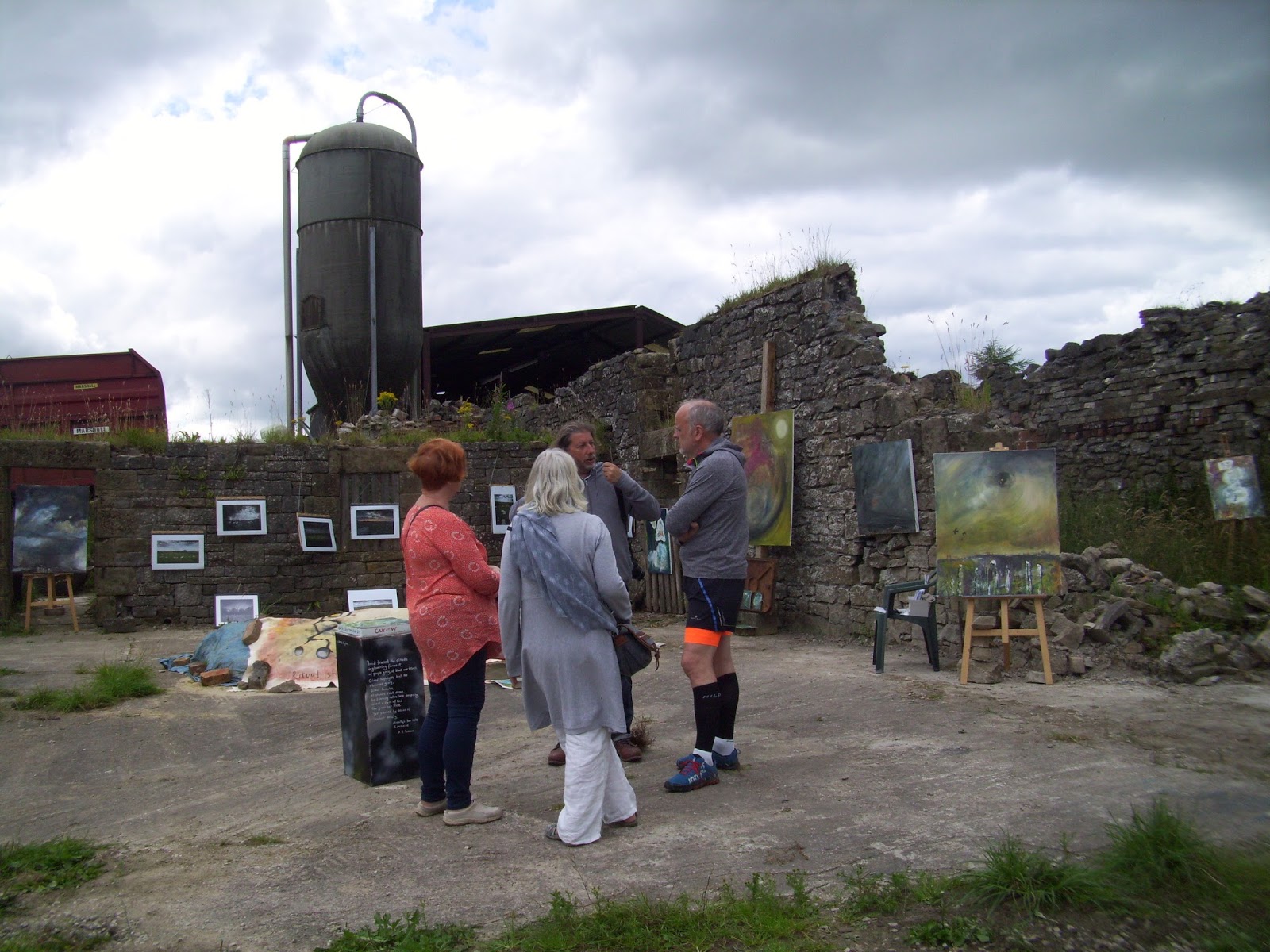
Artist Keith How and photographer Billy Bye held an exhibition of their work at Upper Oldhams Farm, Arbor Low this weekend.
I wrote some words.


 Mysterious and awe inspiring for thousands of years, folklorists, antiquarians and archaeologists have their own theories about its historical and cultural significance. Whatever might be their truths, those ditches were dug, those stones were shifted for a purpose. Nearby Gib Hill has its own story, dating back to the Bronze Age. Roman soldiers gazed in wonder as they marched past on their way North. What did they make of it? Did they recognise something and compare it to Stonehenge and Avebury, or the Bull Ring, its sister henge in Derbyshire?
Before the stones were laid, before the cove was created, before this plateau of Middleton Moor found its level above the sea, tropical lagoons covered this landscape, sea creatures lived and died, their skeletons forming the beds that became the limestone rocks, now fissured and worn, with their own rock pools of rainwater. Bones and stones. A human skeleton was buried in the cove, the group of rocks in the middle of the circle. Another was cremated, ashes buried in the kist at Gib Hill.
Look around and notice the lie of the land, the shapes of the henge echoed by the far horizons of the surrounding hills. Look above to the heavens. Enter the spirit of the skylark and see the shapes from the air. It could be a clock face, it might be a heart, it’s an oval, an egg. Timeless and eternal, in the present it’s a focus for awe and love, pagan spirituality and nature worship. It’s a portal and a place to connect with people who share a common purpose and a shared love for the environment and wild places, who care about the spiritual and natural environment, who need a sense of belonging in their local landscape and the cosmos.
This place has had its champions and custodians over the centuries. There is a welcome to enter in from those who live here. They understand its importance. Solstice celebrations at the turnings of the year bring visitors. Ice sculptures are created from blades of grass in December, paths are hidden in the mist. In June the sound of drums accompanies the skylarks’ song and the planes flying overhead. Throughout the year, in any season, there are those who find their way here with a bunch of wildflowers, a crystal, a drawing, an offering left in a cleft of the stones. It’s a place of pilgrimage and a place of deep connection.
Mysterious and awe inspiring for thousands of years, folklorists, antiquarians and archaeologists have their own theories about its historical and cultural significance. Whatever might be their truths, those ditches were dug, those stones were shifted for a purpose. Nearby Gib Hill has its own story, dating back to the Bronze Age. Roman soldiers gazed in wonder as they marched past on their way North. What did they make of it? Did they recognise something and compare it to Stonehenge and Avebury, or the Bull Ring, its sister henge in Derbyshire?
Before the stones were laid, before the cove was created, before this plateau of Middleton Moor found its level above the sea, tropical lagoons covered this landscape, sea creatures lived and died, their skeletons forming the beds that became the limestone rocks, now fissured and worn, with their own rock pools of rainwater. Bones and stones. A human skeleton was buried in the cove, the group of rocks in the middle of the circle. Another was cremated, ashes buried in the kist at Gib Hill.
Look around and notice the lie of the land, the shapes of the henge echoed by the far horizons of the surrounding hills. Look above to the heavens. Enter the spirit of the skylark and see the shapes from the air. It could be a clock face, it might be a heart, it’s an oval, an egg. Timeless and eternal, in the present it’s a focus for awe and love, pagan spirituality and nature worship. It’s a portal and a place to connect with people who share a common purpose and a shared love for the environment and wild places, who care about the spiritual and natural environment, who need a sense of belonging in their local landscape and the cosmos.
This place has had its champions and custodians over the centuries. There is a welcome to enter in from those who live here. They understand its importance. Solstice celebrations at the turnings of the year bring visitors. Ice sculptures are created from blades of grass in December, paths are hidden in the mist. In June the sound of drums accompanies the skylarks’ song and the planes flying overhead. Throughout the year, in any season, there are those who find their way here with a bunch of wildflowers, a crystal, a drawing, an offering left in a cleft of the stones. It’s a place of pilgrimage and a place of deep connection.


Saturday, 30 July 2016
1966 and all that
So it's 50 years since England won the World Cup. This morning the presenter of Radio 4's Thought For the Day harked back to 1966. He described it as post-war, with bomb sites undeveloped among the city and suburban streets. I remember it well. Manchester's Arndale hadn't yet been built. The city centre was Dickensian. There was a bomb site where my sister and I played near our house. Close by was an area of devastation known as Swinton Fields. We rode our bikes there, up and over embankments for long demolished railway tracks.
On July 30th 1966 my sister and I were staying with my godmother, my aunt in the Isle of Man. School summer holidays, we were aged 11 and 12. Normally we would have been down on the stony beach at Port Jack, skimming stones, climbing rocks and making use of the disguised sewage pipe to walk out into the waves, past the cave in the cliff. But for some reason, though we weren't football fans, we stayed in, watching the game on her small black and white television. My aunt's flat was on Royal Terrace.The first floor living room had a bay window overlooking Douglas Bay from Onchan Head. While she lived there, I've seen the Red Arrows fly so close over the headland and past that window that you could imagine you saw the colour of the pilot's eyes. It was a sunny afternoon. We watched with concentration and fascination, calling my aunt in to join us for the last fifteen minutes. It was impossible not to get caught up in the excitement of the result, and in my mind's eye I see it in glorious colour.
Saturday, 25 June 2016
A sense of place
It's only a couple of weeks since I spent a day thinking about the notion of a sense of place, thanks to the Humanities in Public initiative at Manchester Met and one of their events, held near Hope.
I was full of inspiration to write about places I know and love, mostly in this country.
Today I feel like a stranger in a strange land. Ironically the success of the Leave vote in the EU referendum has made me feel like I'm living in a foreign country. I'm struggling to recognise it.
I was shocked that Sheffield, my new home, known as a City of Sanctuary, voted Leave. As a region South Yorkshire benefitted from EU funding when no-one else wanted to know. Memories are short it seems. I couldn't continue listening to the Radio 4 special from here this morning. I don't know anyone round here who thought we should leave, but I may be making assumptions. I'm very aware I have misread the attitudes of some friends and family members over the last few weeks. It's been even more difficult to second guess colleagues , though I have been comforted by support at work in the last couple of days. The shock of the result of the vote was much greater than I had anticipated yesterday. It seems many others felt the same, sick, despairing and full of dread for the future.
I've grown up through the Cold War years, with the threat of nuclear war, through the Thatcher and Reagan era, the Falklands War, the first Gulf War, the Troubles, the disappointment of the Blair years and a second Gulf War, recessions and three day weeks, fuel crises, racism and right wing threats. I've nailed my colours to the mast and been actively involved in alternative approaches to the economy, the spiritual life, education and good health. I'm stoical and I'm a survivor. I know I'm not alone.
These are unpredictable times. What is predictable are the broken promises to the Leavers and a damaged economy for all. At the moment the news seems dominated by Eton rivals and particularly vicious party politics.
After the shock and numbness of the last couple of days, it's time to take stock and refuse to feel helpless. There's never been a greater need for hope.
Thursday, 9 June 2016
Paul Graney's archives
On Tuesday evening I went to a talk at Central Library in Manchester about Paul Graney. Organised by Archives+ as part of the Manchester Histories Festival, it was free and only an hour long. David Govier and Fiona Cosson had done a great job distilling a life time of recording, witnessing and collecting into an introduction to Paul Graney's achievements. There were people in the audience who knew him and appreciated his role in collecting social history, folklore and folk music, including Barry Seddon, who has done so much work with his archive and Mike Harding, who was thrilled to see photos of the first Middleton Pace Egg play revival from 1967, featuring him in the role of The Doctor (no, not that one).
The extracts from interviews and recordings were great to hear. The taped letters from around the world and the live performance of a collected traditional song about mill girls added to the experience. A lot was packed into that hour, which was over far too quickly.
I love listening to this kind of witnessing - oral history interviews, music recordings, interesting radio programmes.
As each piece was played, I could relate to it, recognising some connection with my own life and work, even though I never met Paul. My own beginnings in folklore studies took place on the other side of the Pennines in West Yorkshire, and my involvement in social and oral history didn't happen until after Paul's death in 1982.
The tape letters, sent between contacts world wide, reminded me of the reel to reel recordings my sisters and I made for my dad when he was working in Nigeria. Nowadays those people would be using social media and the internet to share news and opinions. Listening to forthright opinions on the new fashion for mini skirts took me back to my early teens. I wonder what that woman would think if she knew they still haven't gone out of fashion. Mention of Kennedy's assassination from an American correspondent took me back to the Friday tea time when my sister and I heard the news, waiting for our favourite programme on TV (Bonanza). My mum was doing the ironing in the kitchen. She burst into tears when we told her and I didn't understand why for many years. Ironically I spend some of my time at work talking to visitors about JFK and his visit to his sister's grave in July 1963. I also occasionally talk about Diana Moseley at work, and it was fascinating to hear Paul Graney's first hand account of clashes with Oswald Moseley's Blackshirts. The song highlighting the mill owners' opposition to the Ten Hours Act was wonderful, sung live - 'on the backs of the Lancashire lasses'. Having recently worked at an industrial mill museum in Derbyshire, with its links with Arkwright and Lancashire cotton, it was very poignant. It was terrifying to hear Paul talk about his own initiation experience in the mills of Burnley. A dark cellar, loom grease, cotton lint, a bag over his head and his trousers round his ankles while a group of mill women did their version of tarring and feathering.I'd heard similar stories from the conversations I've had with former workers at The English Sewing Cotton Companies' mill in Belper. There the initiations took place on the works buses home and involved losing trousers.
He also had plenty to say about libraries and librarians. When living as a tramp he had looked to libraries as a place of warmth and shelter, and harboured a lifelong resentment towards those officious female librarians who had shown him the door. In the early seventies there was a gentleman of the road who walked to Salford Central Library daily, resting and reading the paper in the reference section. A charming man. Many years later, a similar gentleman spent his days in another small branch library where I worked, accepted and welcomed by the staff if not always by the users of the library.
I know Archives+ are looking for ways this particular collection can inspire and create responses. It's an amazing resource available for sharing and a great legacy for the man and his dedicated friends who have made that possible.
Friday, 3 June 2016
Wise moves
Many years ago, when I was part of the Bakewell Arts Festival, I had a dream to book John Cooper Clarke as part of the fun. He wasn't in a good place back then, and I was wisely warned off pursuing it by someone who knew the score. To my amazement he was booked in at Bakewell Town Hall as part of his tour with Mike Garry on Wednesday night. You give up on Bakewell and move to Sheffield and look what happens! I went back to Bakewell to see him and a great night was had by all. I was trying to remember when, where and how often I had seen him back in the late seventies. Alan Wise must have been his manager through some of that time. I was reminiscing about all the support slots he did back in the days when I did the door for Alan Wise. By Thursday afternoon I started to hear rumours that Alan had died, rumours that soon became a fact. How sad, so soon after the recent death of his daughter. Over the last few years I've heard people talk about the huge contribution Alan made to the Manchester music scene, unacknowledged for many years for many different reasons, not least because of the complicated approach to life Alan took. I read a great article in praise of him in a Salford paper today, pointing out that while Alan often owed money, we in fact owed him far more.
My own friendship with him began in the late seventies when I used to do the door for him at Rafters. I had a day job, but loved the buzz of those nights out. When I met up with him at a Martin Hannett event a couple of years ago, he described me as his best ever door girl. For all I know he said that to all of them, but I'm proud that he thought that and remembered to tell me all those years later. I have a theory about it now I'm older. It never occurred to me to help myself to any of the takings, put my mates on the guest list or skive on the job. I was reliable and loyal. Thanks to those nights working for Alan - and he never owed me money, I was always paid - I saw some great music and comedy and met some fantastic people. It's an era of my life that has its own complications. As a result of something that happened whilst I was working for him, I ended up running away to Morocco and working there for a year. Once I came back, I did meet up with him again, but then the Hacienda opened and my part time door job found a new home.
Last time I saw Alan, he asked me to send him a Bakewell pudding. I did. I hope he got it. I suspect he would have preferred a Bakewell tart.
There are rumours that he was working on a book, and I know he had written some memoirs. He appears in James Young's book about Nico, 'Songs They never Play on the Radio', as Dr Demetrius. Fact or myth, I know we will not see his like again.
Thursday, 12 May 2016
Remnants

Subscribe to:
Posts (Atom)